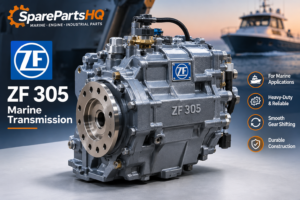
ZF 305 Marine Transmission: Specifications, Features & Buying Guide
Choosing the right marine transmission is essential for reliable power transfer between a boat’s engine and propeller. Whether you operate a recreational vessel, motor yacht or commercial boat, the gearbox must match your engine’s power output, operating speed, propeller requirements and installation configuration.
The ZF 305 marine transmission is part of ZF Marine’s range of marine propulsion gearboxes. It is designed to transfer engine power to the propeller shaft while providing forward, neutral and reverse operating functions.
However, the ZF 305 family includes different configurations, ratios and installation arrangements. Understanding these differences is important when replacing an existing transmission or selecting a gearbox for a new marine installation.
This guide covers ZF 305 features, technical specifications, gear ratios, applications, maintenance considerations and the checks to complete before purchasing.
What Is the ZF 305 Marine Transmission?
The ZF 305 is a marine gearbox manufactured by ZF Marine, a supplier of marine propulsion systems and transmission equipment.
Its primary purpose is to transfer rotational power from a marine engine to the propeller shaft. The transmission also allows the operator to select the appropriate operating mode.
The ZF 305 family includes configurations such as the ZF 305 and ZF 305A in older documentation, as well as later designations such as ZF 305-3 and ZF 305-3 A.
These model variations are important because they can have different mounting arrangements, reduction ratios and technical ratings.
A marine transmission must be selected according to the specific engine and vessel application rather than the model family name alone.
ZF 305 Marine Transmission Features
The ZF 305 family provides several important functions for marine propulsion systems.
1. Forward, Neutral and Reverse Operation
The transmission provides three principal operating modes:
- Forward: Transfers engine rotation to the propeller shaft in the selected forward direction.
- Neutral: Disengages the clutches so the output shaft does not transmit engine rotation.
- Reverse: Changes the output shaft’s rotation direction relative to the engine.
The exact operating arrangement depends on the gearbox configuration and installation.
2. Multiple Reduction Ratios
Different reduction ratios are available across ZF 305 variants.
The correct ratio helps match engine speed to propeller requirements. For example, a higher numerical reduction ratio produces a lower output-shaft speed relative to engine speed.
Always check the gearbox identification plate because the available ratio depends on the exact model and specification.
3. Mechanical or Electrical Shift Control
ZF 305 family documentation describes control valves operated through mechanical or electrical arrangements.
The selected control system must be compatible with the vessel’s existing engine controls and transmission configuration.
4. Marine Installation Configurations
The ZF 305 family includes different installation arrangements. ZF’s product selection documentation identifies the ZF 305-3 as a parallel-offset configuration and the ZF 305-3 A as a 7-degree down-angle configuration.
These differences matter when checking engine alignment, propeller-shaft positioning and available installation space.
ZF 305 Marine Transmission Specifications
The specifications depend on the exact gearbox designation. It is important not to treat every ZF 305 transmission as having identical technical ratings.
The following table summarizes selected information from ZF documentation.
| Specification | ZF 305 family information |
|---|---|
| Manufacturer | ZF Marine |
| Equipment type | Marine reversing transmission |
| Operating modes | Forward, neutral and reverse |
| Control arrangements | Mechanical or electrical, depending on configuration |
| Installation types | Includes parallel-offset and down-angle variants |
| Gear ratios | Vary by model and configuration |
| Lubrication | Transmission oil |
| Identification | Model, serial number and ratio plate |
Selected ZF 305-3 A Specifications
ZF’s Product Selection Guide lists the following details for the ZF 305-3 A:
| Specification | Published information |
|---|---|
| Configuration | 7-degree down-angle |
| Available listed ratios | 1.200, 1.514, 1.733, 2.037, 2.179 and 2.423 |
| Maximum listed speed | 3,000 RPM |
| Weight | Approximately 97 kg (214 lb) |
| Bell housing options | SAE 1, 2 and 3 |
These figures relate to the specific ZF 305-3 A configuration and should not be applied automatically to every ZF 305 family gearbox. The manufacturer’s rating tables also show that allowable input power varies by ratio, engine speed and duty classification. See the ZF Marine Product Selection Guide.
Understanding ZF 305 Gear Ratios
Gear ratio is one of the most important specifications when choosing a marine transmission.
It determines how many revolutions the engine makes for each revolution of the transmission output shaft.
For example, a 2.0:1 reduction ratio means the engine turns twice for every one revolution of the output shaft.
A reduction ratio can help the engine operate within its appropriate RPM range while providing the propeller with suitable rotational speed.
Why Gear Ratio Matters
Selecting an unsuitable ratio can affect:
- Engine operating RPM
- Propeller speed
- Boat acceleration
- Propeller loading
- Fuel consumption
- Overall propulsion performance
The correct ratio depends on the engine’s rated speed and torque, propeller characteristics, vessel displacement and intended operating conditions.
Do not select a gearbox simply because its ratio matches the number on another transmission. Confirm the complete application with a marine propulsion specialist.
ZF 305 vs. ZF 305A: What Is the Difference?
The ZF 305 and ZF 305A are related models, but their specifications should not be assumed to be identical.
ZF’s older operating manual lists different oil-capacity ranges for the two models:
| Specification | ZF 305 | ZF 305A |
|---|---|---|
| Oil capacity listed | 5.5–6.5 litres | 5–6 litres |
| Pump delivery at 1,000 RPM | 11 litres/minute | 11 litres/minute |
| Operating pressure at reference RPM | 23–24 bar | 23–24 bar |
| Operating temperature | 40–80°C | 40–80°C |
These are figures from the older ZF 305 family operating manual. Actual filling requirements depend on the gearbox configuration and optional equipment. Check the identification plate and applicable service documentation before servicing.
The A designation also appears in later ZF model names such as ZF 305-3 A, which has a specified down-angle installation configuration.
Do not assume that the older ZF 305A and later ZF 305-3 A are interchangeable.
Applications of the ZF 305 Marine Gearbox
ZF 305 family transmissions are designed for marine propulsion applications where engine power must be transferred reliably to a propeller shaft.
Potential applications depend on the exact model and duty rating.
These may include:
- Motor yachts
- Recreational powerboats
- Larger pleasure craft
- Selected commercial marine vessels
- Other compatible marine propulsion installations
The manufacturer’s selection guide identifies the ZF 305 family within its marine transmission portfolio. Actual suitability depends on the transmission’s rated power, operating profile and vessel requirements.
A gearbox intended for recreational use should not automatically be assumed suitable for continuous commercial operation.
How to Choose the Correct ZF 305 Transmission
Before purchasing a ZF 305 marine transmission, check the following details.
1. Confirm the Exact Model Number
Start by identifying whether your existing unit is a ZF 305, ZF 305A, ZF 305-3 or ZF 305-3 A.
These designations can refer to different configurations.
Use the identification plate on the gearbox rather than relying only on the vessel’s model or a seller’s general description.
2. Check the Reduction Ratio
Record the ratio displayed on the identification plate.
Compare it with your engine speed, propeller specifications and vessel requirements.
A transmission with an unsuitable ratio can affect engine loading and propulsion performance.
3. Verify Engine Power Compatibility
Check the engine’s maximum rated power and operating RPM.
The gearbox must be approved for the engine’s power and the intended duty classification.
ZF provides different ratings for pleasure, light, medium and continuous duty applications. These ratings should not be treated as interchangeable.
4. Confirm the Installation Configuration
Check whether you need a parallel-offset or down-angle configuration.
Also verify bell housing compatibility, mounting points, output-shaft dimensions and propeller-shaft alignment.
5. Check the Control System
Confirm whether the transmission uses mechanical or electrical shift control.
The controls must work with the existing vessel installation.
6. Review Oil and Cooling Requirements
Check the correct lubricant specification, oil capacity and whether optional cooling equipment is required.
Never rely on a generic oil-capacity figure when the exact gearbox variant is known.
7. Inspect Condition and Documentation
For a used gearbox, review its service history, operating condition, identification plate, signs of oil leakage and any available inspection reports.
For a new gearbox, verify its part number, included components, warranty and manufacturer documentation.
ZF 305 Marine Transmission Maintenance
Regular maintenance helps protect the transmission and identify developing problems before they cause serious damage.
ZF’s older ZF 305 family operating manual includes maintenance instructions covering oil levels, filters, lubrication, control linkages and flexible couplings.
Important maintenance areas include:
Transmission oil: Check the oil level according to the manufacturer’s procedure and use the specified lubricant.
Oil filter and suction strainer: Inspect and service filtration components according to the applicable maintenance schedule.
Control linkage: Check that the shift mechanism reaches its specified operating positions. Incorrect adjustment can affect clutch engagement.
Flexible coupling: Inspect the coupling for wear, damage and alignment issues.
Leaks: Check the gearbox housing, seals and connections for signs of oil leakage.
Operating temperature and pressure: Investigate readings outside the specified operating range.
The older ZF 305 family manual identifies an initial oil change after 50 operating hours and subsequent changes every 1,000 hours or 12 months, whichever occurs first. Always confirm the correct schedule for your specific transmission and current service documentation.
Common ZF 305 Marine Transmission Problems
A marine gearbox may develop operating problems because of insufficient maintenance, incorrect installation, control-system faults or internal wear.
Some symptoms that deserve inspection include:
Difficulty Engaging Forward or Reverse
This may be associated with incorrect shift-linkage adjustment, hydraulic pressure problems or internal clutch issues.
Unusual Noise
Grinding, knocking or other unusual sounds may indicate a mechanical problem, lubrication issue or alignment concern.
Oil Leaks
Leaks around seals, connections or housing components can lead to insufficient lubrication if not addressed.
Overheating
Excessive operating temperature may be associated with oil problems, cooling issues, excessive loading or other mechanical faults.
Delayed Engagement
A delay when selecting a gear may indicate a control, pressure or clutch-related problem.
These symptoms do not identify a specific failed component by themselves. Have the transmission inspected by a qualified marine technician before continuing operation if serious problems are suspected.
Frequently Asked Questions
What is a ZF 305 marine transmission?
The ZF 305 is a marine reversing gearbox designed to transfer engine power to a vessel’s propeller shaft. It provides forward, neutral and reverse operating modes, with different configurations and reduction ratios available across the model family.
What is the difference between ZF 305 and ZF 305A?
The two models have different specifications in the older ZF family documentation, including different listed oil-capacity ranges. Later model designations also include different installation configurations. Always identify the complete gearbox model before comparing specifications.
What gear ratios are available for the ZF 305?
Available ratios depend on the exact model and configuration. For example, ZF’s selection guide lists multiple ratios for the ZF 305-3 and ZF 305-3 A. Check the gearbox identification plate and the applicable manufacturer selection table.
How much oil does a ZF 305 transmission hold?
The older ZF operating manual lists 5.5–6.5 litres for the ZF 305 and 5–6 litres for the ZF 305A without optional equipment. Actual capacity depends on the exact configuration and installation. Follow the correct manual and oil-level procedure.
Is the ZF 305 suitable for commercial vessels?
Suitability depends on the exact gearbox rating and operating duty. Check the manufacturer’s duty classification and power ratings before using a transmission in a commercial or continuous-duty application.
How do I identify my ZF 305 gearbox?
Locate the gearbox identification plate and record the model, serial number, reduction ratio and part-list number. These details help identify the correct replacement or service parts.
Where can I find ZF 305 marine transmission parts?
Start with the exact model and serial number, then compare the required components with the manufacturer’s parts documentation. You can also explore the SparePartsHQ marine gearbox category for available marine transmission equipment.
Final Thoughts: Choosing the Right ZF 305 Marine Transmission
The ZF 305 marine transmission is part of an established marine gearbox family, but choosing the correct unit requires more than matching the model name.
Reduction ratio, engine power, duty classification, installation angle, shaft configuration and control arrangement all affect compatibility.
Before purchasing, record the complete gearbox identification details and compare them with the manufacturer’s technical documentation.
Explore the SparePartsHQ Marine Gearbox category to compare available marine transmission options and related equipment for your vessel.